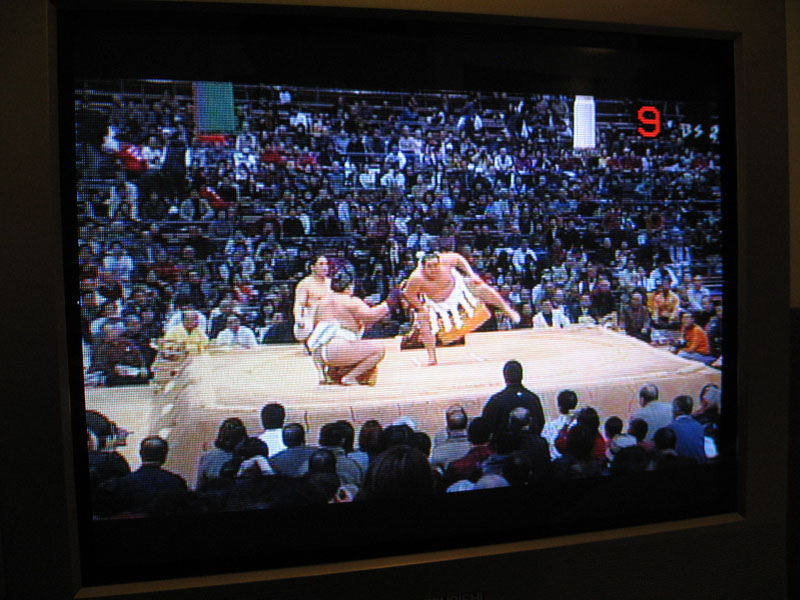
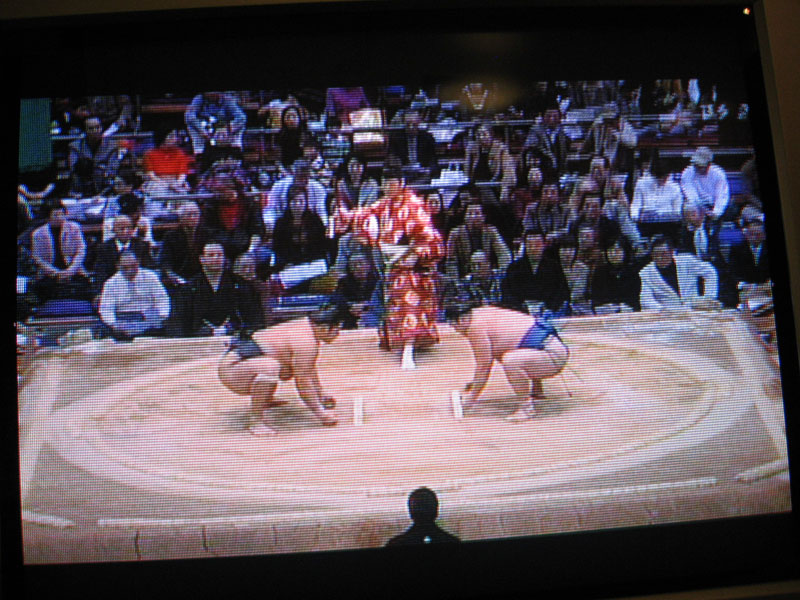
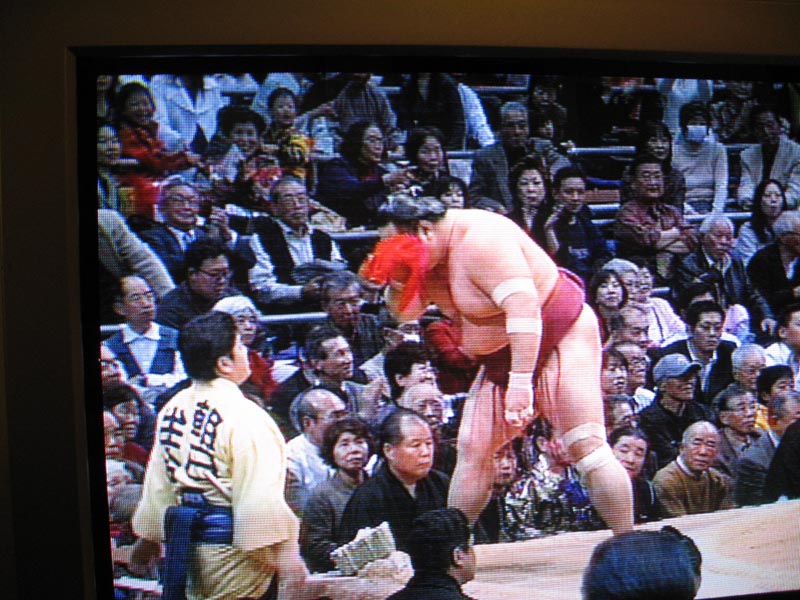
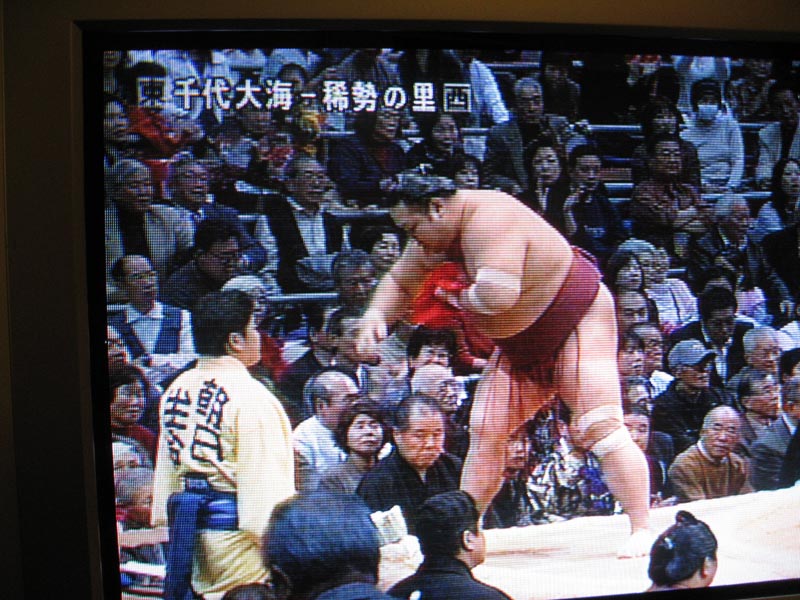
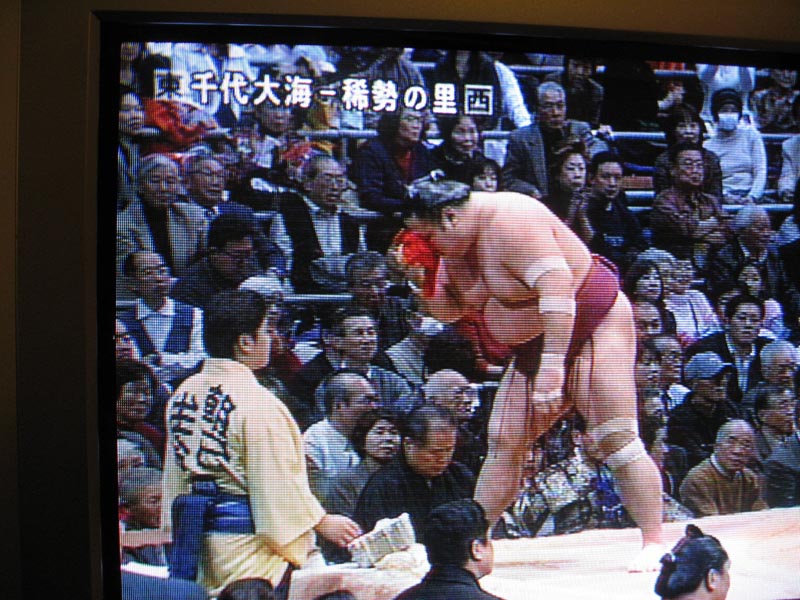
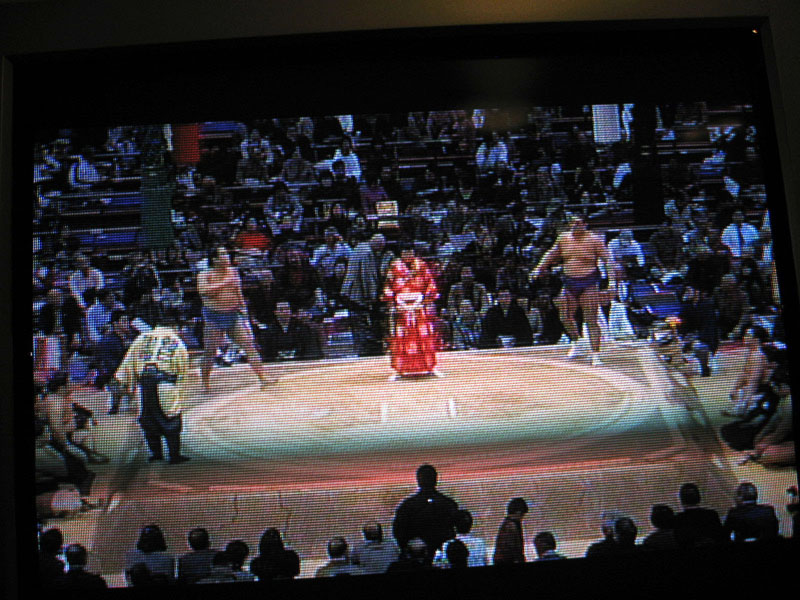
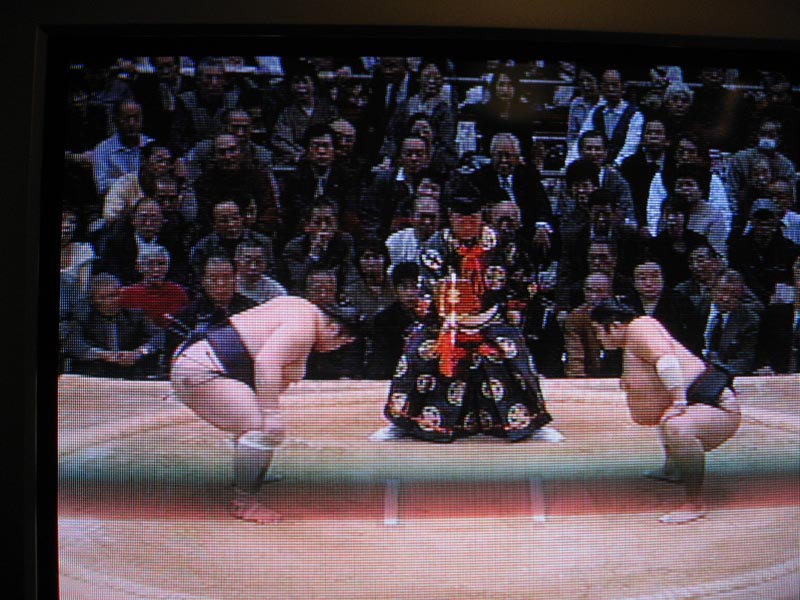
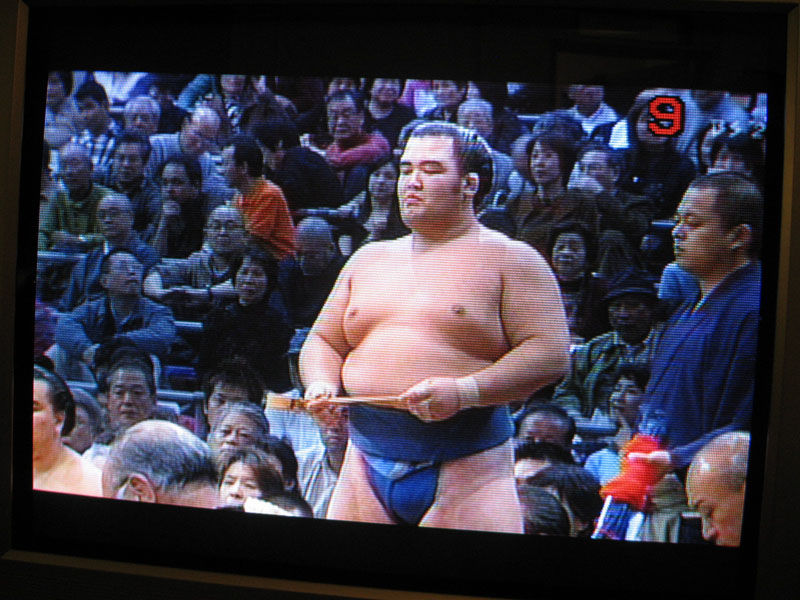
Pictures of the November 2006 tournament held in Kyushu as seen on the TV in our hotel room. If you want good quality NTSC video, you can order DVDs of sumo tournaments from Sumo Now!.
We often watch foreign television on our trips, and the only thing we can find to understand is usually a sporting event. We don't watch football or soccer or basketball or tennis. We find things like snooker or snow boarding or mogul racing. This time we found sumo. We came across the Fukuoka tournament, one of the six 15-day tournaments sponsored each year by the national sumo association. Starting about day 7, we watched 8 days of this tournament, missing only one day when we were late getting back from Mashiko.
The best parts of sumo are the very brief bouts of combat, but much more time is taken up by the many rituals that come before and after that. This is a beginners' catalog of sumo rituals. We saw them during the tournament that is held every year in November in Fukuoka, on Kyushu, the large southern island. There are five other tournaments held the odd months in Nagoya (July), Osaka (March), and Tokyo (January, May, and September). Each consists of 15 consecutive days of bouts, with all the participants wrestling once a day. Each tournament is broadcast on NHK for three hours a day, 3:00-6:00 PM, without a single commercial break. There were some news flashes one night, when a tsunami alert was issued for Hokkaido and northeastern Honshu.
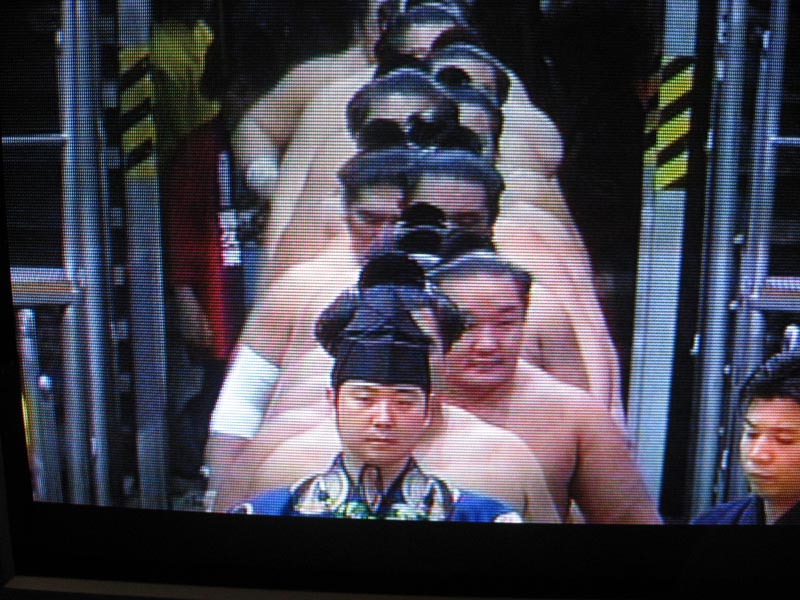
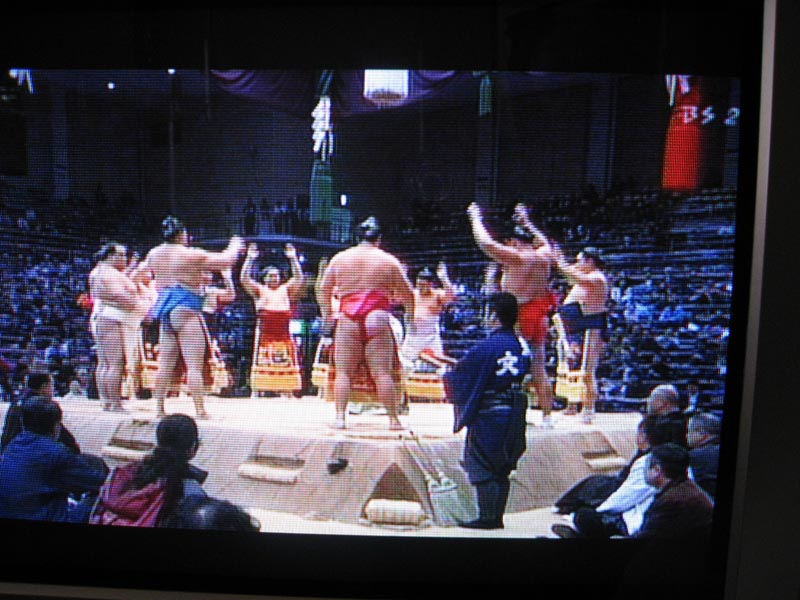
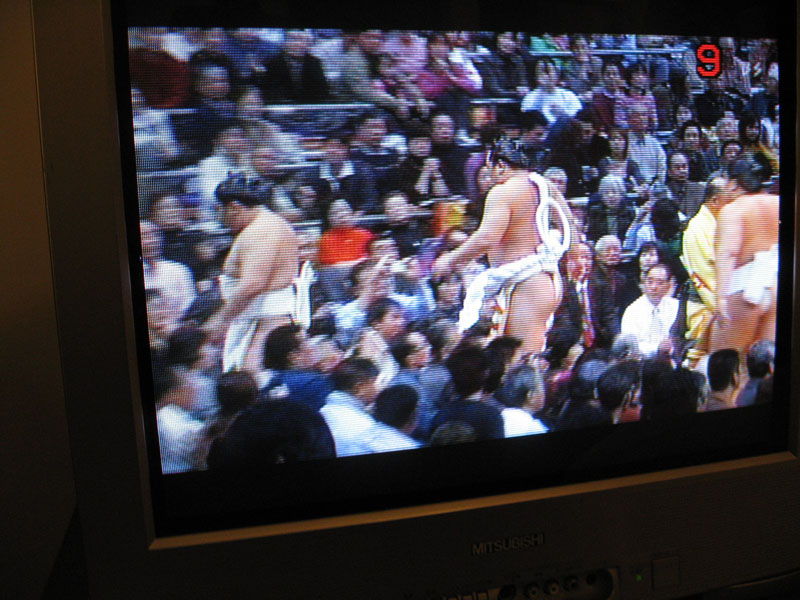
A small roof is suspended over the ring. There are about 700 professional sumo wrestlers in Japan, ranked in six divisions Only the top two divisions participate in the televised tournaments. There are 42 wrestlers in the highest division and 28 in the next lower division, so there are 35 matches per day. Each day the lower division wrestles first, to a rather sparse audience. The high-ranking group wrestles later, and you can see the audience swell as the last bouts of the day approach, between the highest ranked wrestlers. Each division is divided into east and west groups, and the division performs an opening ceremony before the first bout. This begins with a parade down the aisle with the wrestlers dressed in fancy aprons. Here the east group of the higher division is beginning its parade, preceded by an official in a blue kimono. Here they are entering the ring. They first form a circle facing outward, toward the audience. Then they face in, and do some ritual motions, before filing out again. Then the west group does its parade.
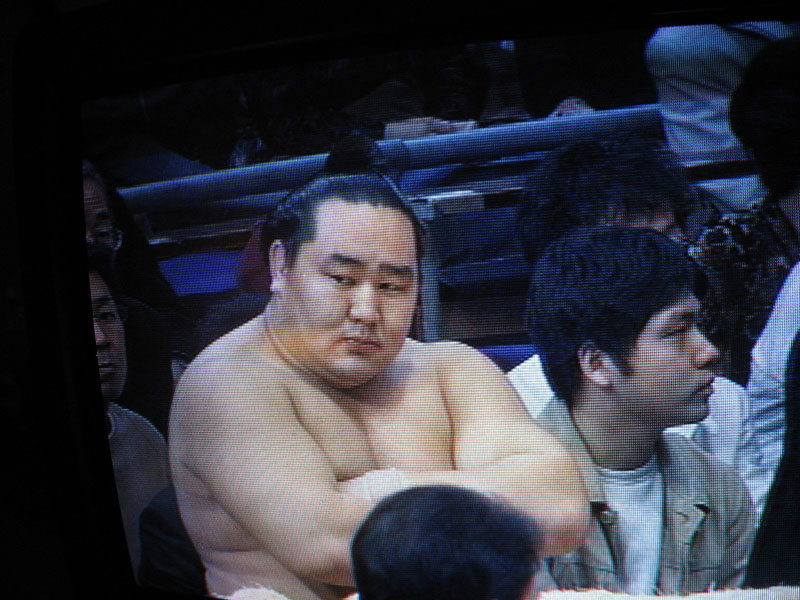
Within the top division there are four ranks, with the top rank being yokozuna. At various times there have been as many as four wrestlers ranked yokozuna and as few as none. Currently there is only one wrestler in the yokozuna rank. The yokozuna performs a separate opening ceremony assisted by two high-ranking wrestlers. He also has a special yokozuna costume as well as an apron. In front is a a series of white zigzags. In back is this big white rope loop, which you see as he leaves the ring at the end of his ceremony. Asashoryu is the only yokozuna at this time. Here he is, waiting for his match. He won all 15 matches in this tournament.
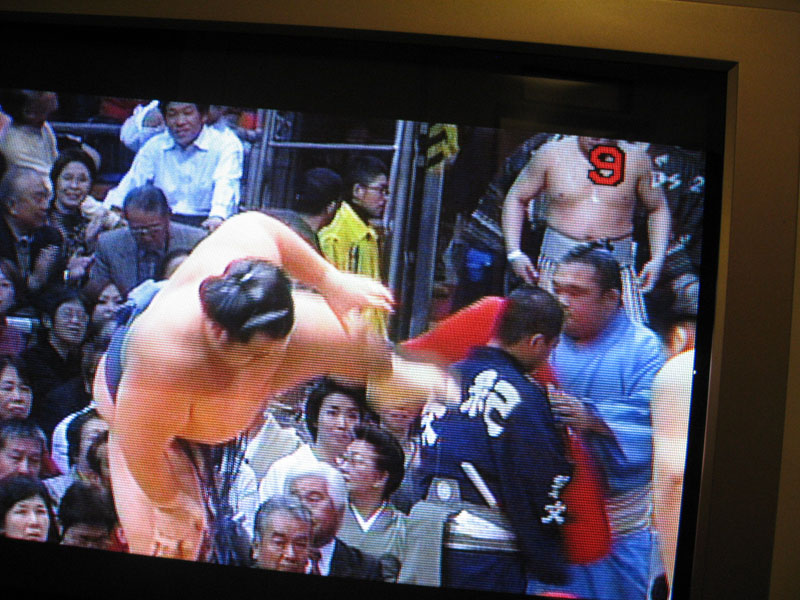
Soon after getting into the ring, each wrestler in his corner does a stomp ritual, a sort of warm up and stretch exercise. The referee announces the match, and the wrestlers come to the center of the ring for the first of several face-offs before the wrestling begins. Higher ranked wrestlers get more preliminary face-offs, so their bouts take longer. You can tell this face off is still preliminary, since the referee is holding his baton off to one side and his body is sideways to the camera. After a preliminary face-off, both wrestlers return to their corners to perform one or another ritual. This is the three-part towel ritual, which usually only higher-ranked wrestlers have time to perform. Step one is to wipe the face. Step two is armpits. Step three, blow your nose. Returning to the ring for the next face-off, usually both wrestlers will throw a handful of salt into the ring. Some will do a low pitch, others, a high spray, presumably to show how worked up they are. Sweepers work around the ring until just before the final face off. I'm not sure why they are sweeping; perhaps they are spreading the salt around that both wrestlers have thrown into the ring as they come out of their corners to the face off. Since the referee has his baton held out of front of him with the flat toward the camera, you know this is the final face-off before wrestling begins. The bout can start after both wrestlers have at least one hand on the ground behind the white line.
The winner sometimes is awarded money by sponsors of that particular bout. This winner is taking away a group of envelopes with a few hundred dollars per envelope provided by commercial sponsors that the referees has given him. To get to this point, the referee faces the kneeling winner and holds out the pile of envelopes on his baton. The winner makes some ritual passes of his right hand over the pile, sort of like making the cross, then picks up the pile.
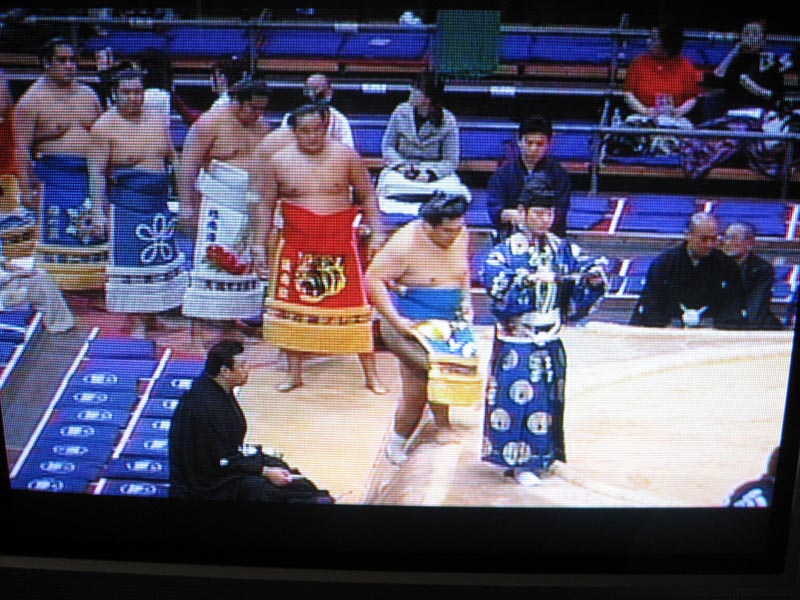
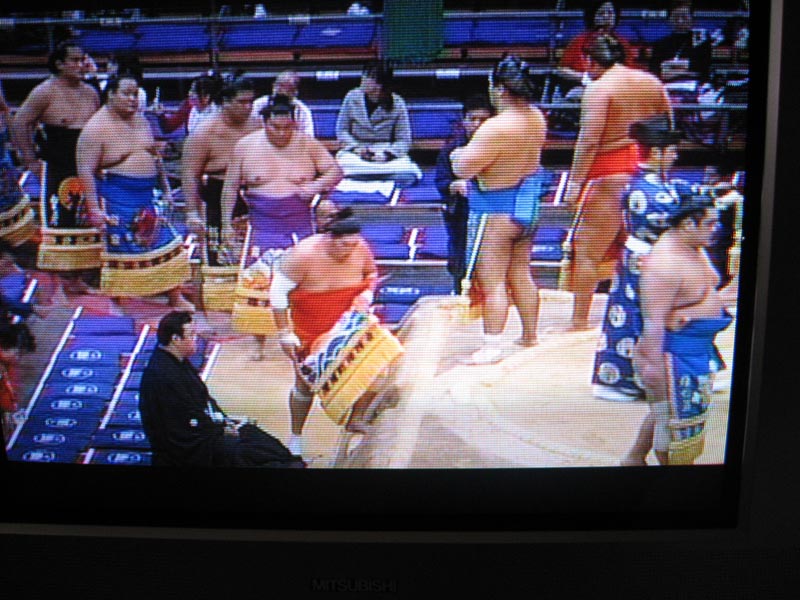
After wrestling, a wrestler offers water to one of the participants in the next bout. Here he is holding the water in a ladle, waiting for the next wrestler. Here the upcoming wrestler has taken the water, and he is then offered a small piece of paper, which he will hold in front of his mouth when he spits the water downward.