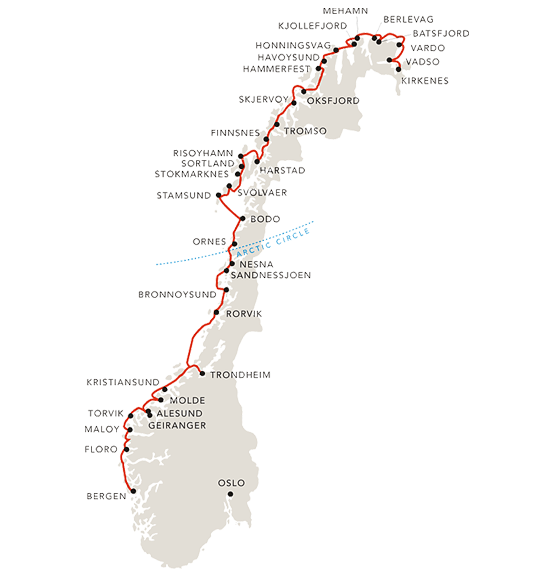
NORWAY AND DENMARK 2010
We had wanted to take the Hurtigruten cruise ever since our first visit to Norway in 1999. Fjords and mountains make interior transportation difficult, so since 1893 there has been a
coastal steamer service to carry passengers, cargo and mail up and down the coast of Norway. It's called the Hurtigruten (fast route), and a ship leaves
northbound once a day from Bergen and one southbound from Kirkenes. We chose to take the northbound trip, and planned to follow it with visits to Denmark and northern Germany. I had all the transportation (airlines, ship, train, and rental car) and hotels reserved ahead of time. We would spend 5 nights in Norway, 6 on the Hurtigruten, 7 in Denmark, and 7 in northern Germany. A volcano in Iceland didn't agree with those plans.
4-5 April Flight to Oslo
We flew Austrian Airlines from Dulles to Vienna to Oslo. The food and flight were acceptable. We took the SAS bus from Kastrup Airport to the SAS hotel in Oslo, and walked to our hotel,
Cochs Pensjonat. This former boarding house is kitty corner from the royal palace, at the top of a hill looking down an avenue through downtown Oslo, a city with a population of 590,000. Cochs has character. Our room was comfortable and white, with plenty of space to store things. The bathroom floor was heated, a feature new to us that rapidly became a necessity as we got used to it in our other lodgings on this trip. Several notable Norwegians had stayed in our room, including Lars Saabye Christensen, author of The Half Brother (2001), a novel set in Oslo with references to Cochs Pensjonat.
The TLS review We walked into town past the palace, and
saw this soldier on guard duty in front of the guard house next to the palace.
6 April Oslo
On our first full day of the trip we visited the National Gallery and the Museum of Decorative Arts and Design. They're both excellent museums with good permanent and temporary exhibitions, but no photos were allowed. I think Oslo is over-reacting to two spectacular burglaries of Munch paintings, one from the National Gallery in 1994 and the other in 2004 from the Munch Museum. The web sites don't even provide pictures of their collection.
7 April Oslo
We did some shopping, to buy a rainproof knit hat for Mariana, and then took the tram to the
City Museum, which covers the history of Oslo. Oura visit coincided with dozens of mothers and their babies who
filled the lobby and cafeteria. The baby carriages
littered the entrance. The museum adjoins Vigeland Sculpture Park, with hundreds of bronze and stone sculptures by Gustav Vigeland. He chose unusual subjects:
8 April Oslo --> Bergen
We took the train to Bergen, a 6 1/2 hour trip. We were in Komfort class, with free hot drinks, seats with power outlets, lots of wood, and good lighting. As you can see
on this map, we passed through several skiing sites, and there were many skiers on the train.
9 April Bergen
- The Hanseatic Museum. There is an area in Bergen called Bryggen that was an German enclave used from 1360 by the Hanseatic League. It is now a
World Heritage Site, and some existing buildings date from 1702.
- These are "original" Byrggen buildings. There was a lot of new lumber used to hold these buildings together. They housed the agents of the Hanseatic League and the goods they traded with Norwegians.
- Street between two Bryggen buildings Space was limited in Bryggen.
- These elbow beams may have been salvaged from ships
- View of the hill north of Bergen from in front of the art museum
- Our ship for the Hurtigruten, the MS Midnatsol. The bow is to the left. We boarded at 5:30 PM and the ship left Bergen at 10:30.
- Our cabin, class P. We were very pleased with the amount of space we had, the furnishings, the heated floor in the bathroom, the lighting, and the view.
- Bathroom to the left, desk to the right, corridor straight ahead.
- Survival suit We were shown how to get into one of these suits in case the ship were abandoned. It's plainly cold out there, if you need these to survive in a lifeboat.
10 April Hurtigruten day 2
- Måløy, our second stop We weren't awake for the first stop, Florø, at 4:30 AM. Of the 33 port calls we made, 12 were at times when we were in bed.
- Mountains that look like covered dinosaurs near Måløy.
- Mountains as we leave Måløy
- Blue ship There were plenty of ferries, fishing boats, and other short-range, smaller ships at work.
- Small fishing boat
- The bow of our ship in Torvik, the third stop (only 25 minutes).
- Ålesund , the fourth stop. A view as we walked into town during a 3-hour visit.
- The Art Deco Center (Jugendstilsenteret), formerly a pharmacy and a residence. Ålesund was largely destroyed by fire on 23 January 1904, and rebuilt with aid from Kaiser Wilhelm of Germany in Jugendstil style.
- Building with turrets
- Waterfront buildings, residential, I think.
- Every Danish art museum has a chair department
- Fronts of Art Deco buildings
- Ornamental detail
- P.D. Stafseth is a wholesaler of hardware, plumbing and heating equipment and supplies
- Doorway
- Corner of a building
- Detail on that building
- Gothic-Art Deco
- Nice yellow ornamentation
- Hill at Ålesund
- Rica Seilet Hotel at Molde , our fifth stop.
- We were on deck 6, which had a continuous path around the ship used by people for exercise.
- Life chute instructions on the ship We would descend from the boat deck to the boat via a chute. Contrary to these instructions, we would be wearing survival suits.
- Life chute instructions on the ship
11 April Hurtigruten day 3
We liked Trondheim, our seventh stop (six hours), and would like to come back and spend several days here.
12 April Hurtigruten day 4
13 April Hurtigruten day 5
14 April Hurtigruten day 6
- Square-topped mountain south of Havøysund
- Havøysund , our 25th stop (15 minutes)
- Small red house at the base of a huge hill north of Havøysund.
- Snowy hills like soft meringue
- Bridge of the Midnatsol We visited the bridge on a tour this morning, and learned several things about its navigation and maneuvering. The officer in the photo is the navigator; off to the left was the captain. Navigation is by GPS alone; there is no LORAN. The ship is guided most of the time by an autopilot. At some point entering and leaving a port the helm is taken by a human. The ship has no rudder; instead the two propellors in the stern can be rotated through 180 degrees. There are three bow thrusters on each side, for moving sideways toward and away from piers. Normally they use only two thrusters. When the wind or current is too strong for even three thrusters, they drop an anchor and use the capstan to manueuver away from a pier. There are planes to counter rolling, but not pitching. There was only a little rolling during short periods on our trip, and the weather was not bad. Mostly we were not in the North Sea, but were passing between islands.
- Honningsvåg , the 26th stop (3 1/2 hours at lunch time)
- Mariana with troll at Honningsvåg
- Wonderful views through our port hole
- Coming into Kjøllefjord, stop # 27 (15 minutes). Note that this hillside is mostly clear of snow, while
- the facing hill is still covered.
- Closeup of Kjøllefjord
- Wooden boat at Kjøllefjord
- Finnkjerka , a famous sea cliff (we weren't sure why)
- Mountain outside Kjøllefjord , 71 deg 1 min 40.7 sec North, 27 deg 11 min 9.7 sec East
15 April Kirkenes
We learned about the volcano eruption in Iceland and the cancellation of airline flights an hour before landing at Kirkenes at 9:45 AM. We'd planned to stay one night in Kirkenes. We checked into the Hotell Wessell, then walked out to the local history museum, which was quite good.
- Ship's officers telling us about the Iceland volcano
- Final checkout An officer scanned our badges coming and going from the ship, to know who was on board.
- Russian trawlers at Kirkenes . This appears to be where these fishing boats are supplied, though some trawlers have been parked here for years.
- Large ship hall Kimek Offshore repairs and supplies offshore drilling operations, and can accomodate a ship in this huge building when it is being repaired.
- The Snow Hotel It was melting fast, and had no occupants.
- Snow Hotel
- Inside the Snow Hotel there is a bar made of ice. The waitress who showed us around was Russian.
- Husky at the Snow Hotel They run excursions on dog sleds.
- Male huskies Each dog has a house, to which it is chained, to prevent fights. We were invited into this pen to visit the dogs. What a change from the hygenic environment of the ship, where we were asked to use hand sanitizer before and after every meal, and leaving and returning to the ship. Here we were walking through snow, straw, and dog droppings while petting and being licked and sniffed by dozens of dogs.
- Reindeer There were two reindeer at the Snow Hotel, without antlers, and rather shy.
16 April Kirkenes
This was the first extra day in Kirkenes. We walked around the port. The principal businesses in Kirkenes appear to be processing and shipping iron ore, servicing offshore drilling operations, and servicing fishing boats.
17 April Kirkenes
We had been sleeping on a time bomb, and at 11 PM last night it went off. The Hotel Wessell is on top of a disco which operates Friday and Saturday night, and it kept us awake until 3 AM. As soon as we were out of bed we went over to the Rica Arctic Hotel and booked a room. What a relief! And we had a nice lunch of reindeer meatballs in the Rica restaurant.
We were scratching pretty hard for tourist sights by now. We spent a lot of time discussing the options (wait for a flight or take a ship south), and browsing various web sights for news and information. Finally we went for a walk and to a high school wrestling meet.
- Monument to the Soviet Soldier The Germans moved into Kirkenes in 1940 and with their allies the Finns attacked Russia in 1941, aiming at Murmansk, only 91 miles southeast as the crow flies. They never got there. Eventually the Soviets counterattacked, the Germans withdrew, burning all towns in Finnmark, including Kirkenes, and Kirkenes was liberated in October 1944. The devestation left by the retreating Germans is remembered well in Northern Norway.
- Fjellhallen is a gymnasium tunneled out of rock in the middle of Kirkenes. They were having an international school wrestling match when we were there: Sweden, Finland, Norway, and Russia.
- The tunnel leading to the gymnasium is closed by a blast door. This was built after WW II.
18 April Kirkenes
No flights again today, and we began looking into the possibility of taking a Hurtigruten ship back to Trondheim and a train back to Oslo. We couldn't get an outside line using the hotel phone, but connected easily to the ship using my iPod Touch and Skype. Skype is wonderful, if you have an wireless network. We took an excursion today conducted by a 22-year old German who has moved to Kirkenes from Stuttgart.
- Another street sweeper The sidewalks in many towns are scored by grooves, perhaps by snow plows. The production, distribution, and cleanup of grit must be a big business in Norway.
- Sign post to home erected by Austrian soldiers stationed in Kirkenes during WW II.
- View of the town looking west. The Sydvaranger ore processing plant is on the left, the Kimek Offshore buildings on the right, and the ore-loading pier below, on the fjord. The town is booming, with people holding multiple jobs and unemployement below 1 %.
- Russian-Norwegian border sign We took a tour of the area with a couple from Hamburg.
- Russian and Norwegian border markers.
19 April Kirkenes --> Alta --> Oslo
Escape from Kirkenes! We were loaded onto an SAS bus at 10:45 AM, for a 6 1/2 hour drive west to Alta, where an airport was open. Most of the seats were taken by passengers just landed from today's Hurtigruten, and Mariana sat next to a woman in her 70s from Stuttgart, and I sat next to a German man.
The route went through the top of Finland. Russia is just east of Kirkenes, and the middle third of the trip was in Finland. The scenery was interesting, and went down a canyon just before arriving at Alta, with beautiful frozen waterfalls; but we were seated on the aisle and the bus windows were tinted, so our photos are bad.
The airport at Alta was much nicer than I'd expect in an American town of that size (population 17,000). I put that down to the fact that a single government agency, Avinor, builds and runs all Norwegian airports. Central government aid may also account for the high quality of Norwegian museums. You wouldn't expect to find locally the specialized skills needed for exhibition design as good as we saw in museums in Trondheim (pop. 171,000), Ålesund (pop. 42,000), Bodø (pop. 46,000), Tromsø (pop. 67,000), and Kirkenes (pop. 7,000). We were also impressed by the services provided by the national airline, SAS. We have relatives that had tickets to Connecticut but were abandoned in Albany with no aid given by their American airline, responsible only to their shareholders. SAS paid for our lodging and meals in Kirkenes, the bus trip to Alta, the flight to Oslo, and our hotel and meals in Oslo. And then there is the national railroad system and the public transportation in Norway (pop. 4.9 million). The comparison to Amtrak and the Washington Metro is not to our advantage. It's very interesting to see the generally high level of competence and quality of public life in Scandianavian countries that are much smaller than the USA. Since we didn't see inside private homes, we can't compare our private quality of life to theirs. [Op-ed piece ends here]
20 April Oslo
We learned last night that Copenhagen airport would be closed today, so we spent the day sightseeing in Oslo, instead of wasting time as usual during this volcano episode browsing the internet for information. We went to the open air museum.
- Two boys on the bus to the museum. The one on the right told me he had been born in Ohio.
- Mariana sat across the aisle.
- Stave church moved here to the Norsk Folkemuseum in 1880 from Gol.
- Front of the Gol stave church About 1/3 of the church from Gol was moved; it was circa 1200. The other 2/3 is new material.
- Carving above the entrance
- Carving in the tower
- The entrance is very narrow and framed by carving.
- The interior is also narrow. Stave churches could not accomodate many people, who stood, and were replaced in the 19c by larger, less interesting churches.
- A loft, that stored food and provided guest quarters on a farm in the second floor. The slanting timber to the right of the door marks in interior staircase. It was built on pillars designed to prevent entry by rats. Lofts typically had overhanging second stories.
- Ornamentation over the door
- House from Hove, 1738
- Door of the house from Hove
- Another door on a farmhouse from 165-1700
- Turf roof with bark under the turf, to form a waterproof barrier. The bark layer curls around the pegs holding the heavy wood frame around the turf.
- Carving on door jambs of building from 1730
- Sign from the working pottery at the museum
- Two potters The one on the right is Ellen Kjaergaard. She has investigated traditional Norwegian pottery and uses lead glazes. The potter on the left said that the traditional technique for applying lead glaze was to dip it in a solution made by boiling some plant product, and then blowing a lead compound in powdered form onto the work, to stick to the plant residue. When fired, a glaze was produced. Ellen uses a more modern technique.
- Two pots by Ellen which we brought home
- Inside the bowl
- House in Bygdøy, the district housing the Norsk Folkemuseum
21 April Oslo --> Copenhagen
Escape from Norway!
22 April Copenhagen
We visited the National Museum today.
23 April Copenhagen
24 April Copenhagen --> Middelfart --> Gram
We picked up a car at the Copenhagen airport and drove to Middelfart, about 2 hours by freeway.
The route started on the island of Zealand and crossed most of the island of Fyn. After lunch and a visit to Grimmerhus, the Danish Ceramic Museum, we continued another hour west to Gram, where we spent two nights.
25 April Gram
We spent the day in Ribe.
26 April Århus
We visited the Viking Museum in Ribe, then drove to Århus and looked around a little.
27 April Århus
28 April Århus --> Copenhagen
We drove from Århus to Copenhagen, which involved a ferry ride from Jutland, the European peninsula, to Zealand, the island facing Sweden where Copenhagen is. En route we stopped to see a new museum, part of the National Museum, at
Brede Works, a large fabric mill that operated 1832-1956. The high point of our visit there was not planned by the exhibit designers: an impromptu tour of the National Museum conservation facility where wood from excavated Viking ships is being preserved. The public exhibition depicts the world of individual workers, and you are invited to assume the role of one of six workers: plant manager, master weaver, weaver, burler, knapper, or mill girl. It's dramatized sociology, with nothing much to say about the machines, materials, processes or products. There are two working looms, and Mariana had a long talk with a weaver and fabric designer operating one of those.
29 April Copenhagen
- Tricycle baby carriage
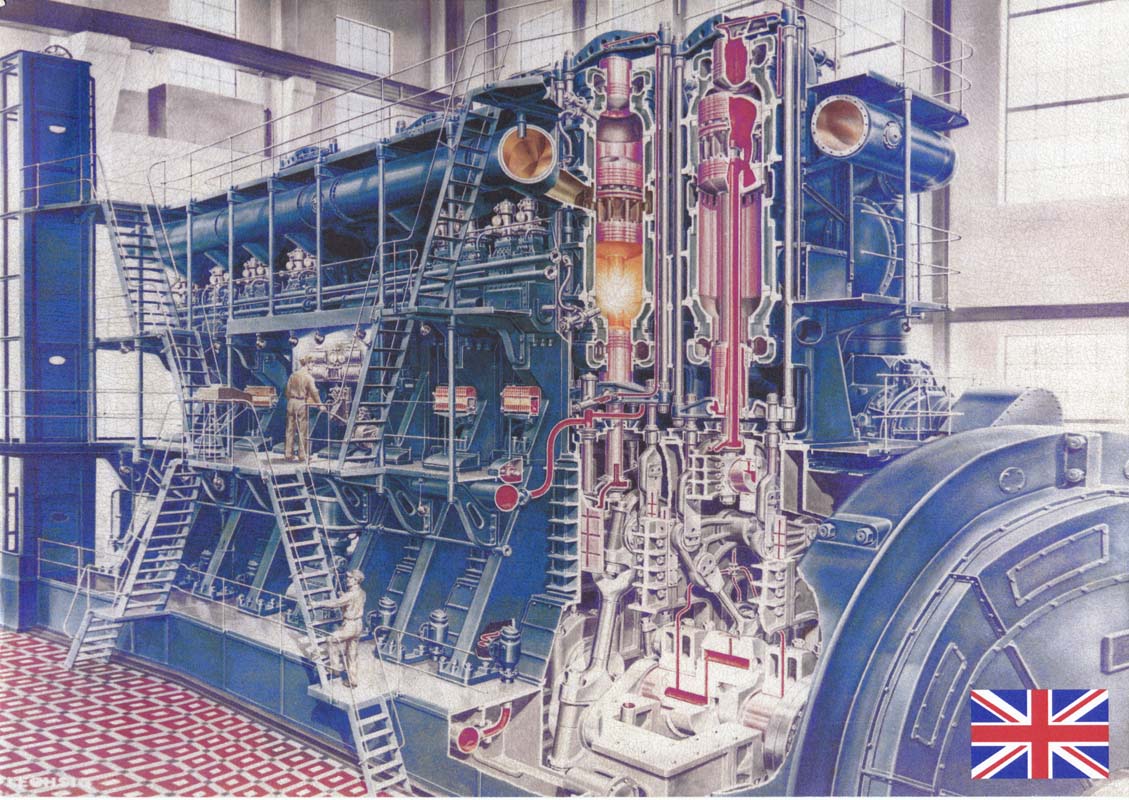
- The three-story diesel at Diesel House. We were fortunate to see them turn the engine on.
- Mosaic of the diesel engine
- Another view The engine has eight cylinders, all vertical and in line. The B&W stands for the Danish manufacturer, Burmeister & Wain. The engine was installed in 1933 and generated peak power and was a standby unit until 2004. It drove a single 15 MW generator.
- Scanned image The generator is in the right foreground. The first two cylinders are cutaway to show the double pistons. There are combustion chambera at the top and the bottom of each cylinder.
- Reverse of the scanned image That's a displacement of 6,650 liters, or more than 1,000 Hummers. Engine output is given in units of metric horsepower (hk, for hestekraft). This unit is equal to 0.98632 horsepower.
Manhole Covers
Scandinavia has good hunting for manhole covers. Towns and counties don't think it wasted money to beautify the streets and pavements with symbols of the community. Here are 21 separate designs.
Oslo, 5 Apr Caped man with a halo seated on a pair of lions holding a mill stone? in his right hand and star-headed flowers in his right with a naked woman curving under his feet on a circular field of Greek crosses (plus signs)
Oslo, 5 Apr Ten houses at various orientations interspersed with umbrellas? and two lines of palisade fence
Bergen, 8 Apr Bryggen (3 gables in a row) with a stepped gable to the left and a square tower behind, a funicular car and a cable car to the upper left and waves and a square rigged ship in the right foreground
Alesund, 10 Apr A longboat with a square sail on water with fish below on a field of alternating vertical and horizontal lines
Alesund, 10 Apr A shield with a longboat with a square sail on water with fish below. Above the shield a crown of battlements and below "ALESUND KOMMUNE". Around all this a ring of nine symbols drawn with a single line: the Norwegian flag, a dog-dragon head and neck, an eye, two arms held up with hands open, a five-pointed star, a globe with lines of latitude and longitude, an open hand, two five-pointed dancing stars, and a cross.
Alesund, 10 Apr "1904" above an Art Deco knot of 3 strands with a lattice work of flowers right and left, like a stained glass armature and "Alesund" below
Alesund, 10 Apr Ten houses at various orientations interspersed with umbrellas? and two lines of palisade fence. Seen earlier in Oslo.
Molde, 10 Apr A crown on top of a shield showing the tail and spout of a whale and 3 waves of water. (Molde was saved from famine by a whale that chased a school of herring up the fjord to the town.) Under the shield is "MIV". The shield and MIV are inscribed in a circle in a field of dots
Trondheim, 11 Apr A circle of crenellation around two masonry structures with three faces below and in the middle. I the left structure under a canopy topped with a cross is a bishop with his crozier blessing the figure on the right. The structure on the right is a castle holding a king with a crown and holding the scales of justice. The 3 faces below may have haloes; the center one has a small beard.
Harstad, 13 Apr A shield with three wavy horizontal bands surmounted by a crown in a circle within a field of heart-shaped darts. Inside the circle "Harstad Commune".
Finnsnes, 13 Apr A shield with a knife, fork, and spoon laid bottom right to top left in a field of squares. Below the shield "Lenvik Commune"
Tromsø, 13 Apr Reindeer in a square inscribed in a circle on a field of heart-shaped darts
Kirkenes, 15 Apr Ten houses at various orientations interspersed with umbrellas? and two lines of palisade fence. Seen also in Oslo and Alesund.
Kirkenes, 17 Apr A shield with three flames pointing up to the right in a circle in a field of heart-shaped darts.
Kirkenes, 18 Apr A fan of dashed lines radiating from a hole on the edge superimposed on a field of carets, some complete and some fragmentary. Rectangular box opposite the hole around a number (obscured).
Oslo, 20 Apr Three eight-pointed stars inscribed within each other, with eight radiating lines connecting the valleys between the points.
Oslo, 20 Apr A stylized "SR" underlined in a circle surrounded by two rings of 16 compartments each filled with balls. The inter compartments hold 4 balls each, the outer hold 7 balls. Is this a ball mill, with gaps in the compartment walls to allow powder to exit?
Copenhagen, 21 Apr "E" inside a three-sided near-circle, surrounded by "KØBENHAVNS ENERGI AFLØB" ringed by a wide band of 17 elephants in various postures arranged in an outer ring of 9 and an inner ring of 8. AFLØB means "drainage". According to Wikipedia, this utility supplies "gas , water and heat to the citizens of the City of Copenhagen and the handling of wastewater".
Copenhagen, 21 Apr Rain falling on three tall houses each with a single high window and with two four-lobed flowers or bunches of fruit and a single fish, in front of a choppy sea where fish jump. At the bottom "KøBENHAVN"
Ribe, 25 Apr A shield holding three crowned lions on the left and a church on the right with two circular towers and a gable surmounted by three crosses in a field of three rings divided irregularly into 24 compartments by radial and slanting lines and a fourth outer ring divided into 10 compartments by radial lines.
Ribe, 25 Apr Closeup: A shield holding three crowned lions on the left and a church on the right with two circular towers and a gable surmounted by three crosses.
Århus, 26 Apr A large shield holding two seated men facing each other within a lobed vault surmounted by a small round masonry tower between two larger round masonry towers. To the left of the lobed vault is a crescent moon and to the right is a seven-pointed star. The left seated man holds an anchor and the right seated man holds a sword. The anchor is the symbol of St. Clement, patron saint of sailors, who was martyred by having an anchor tied to his neck and thrown into the Black Sea.
Århus, 26 Apr A large shield holding two seated men facing each other within a lobed vault surmounted by a small round masonry tower between two larger round masonry towers. To the left of the lobed vault is a crescent moon and to the right is a seven-pointed star. The left seated man holds an anchor and the right seated man holds a sword. The anchor is the symbol of St. Clement, patron saint of sailors, who was martyred by having an anchor tied to his neck and thrown into the Black Sea.
Copenhagen, 28 Apr In the center a small profile of a man with a top hat surrounded by "KØBENHAVNS ENERGI AFLØS" set in a field of art deco or Japanese style with a large open-mouthed fish at the top, a rat at the lower left, and below an indistinct figure radiating plumage or streamers. The ring the cover fits in is a narrow band with stylized waves or currents of water in which eight mermaids swim.