East Germany, Sep-Oct 2005
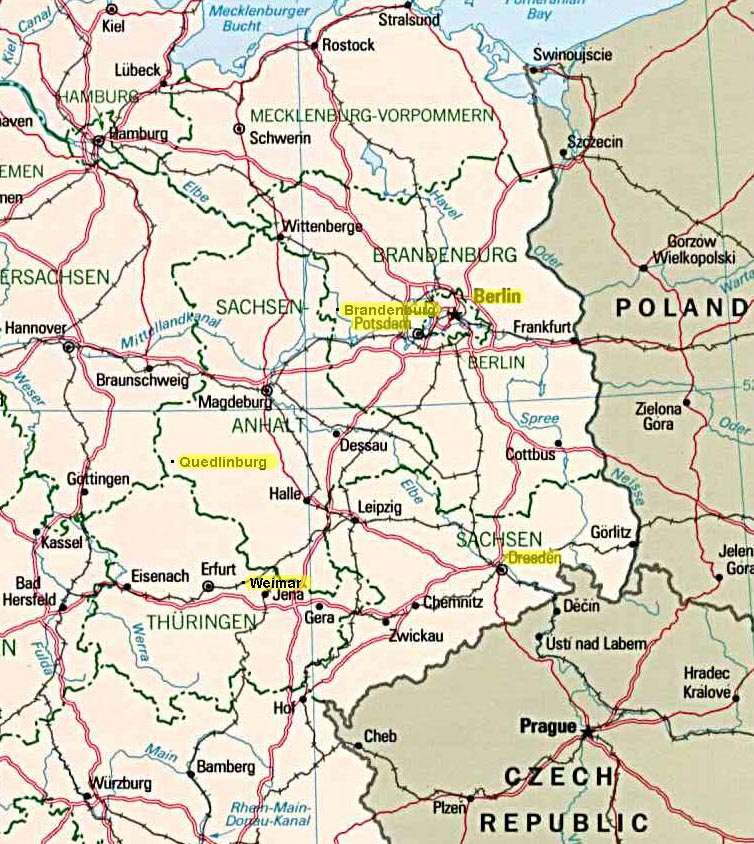
We spent 3 weeks in a clockwise tour through the former East Germany, starting
on 26 September with 6 nights in Berlin. We then drove south through Brandenburg
(the state) to Saxony, and put up in Dresden for 4 nights. Our next move was
west, into Thuringia, where we stayed outside Weimar. We moved to Quedlinburg for
4 nights, in Saxony-Anhalt, and finished close to Berlin with 2 nights in
Brandenburg (the city).
Map of Germany
Small map of cities visited
We rented a Peugeot 1007 from Hertz, a model a bit smaller than we usually get,
but very distinctive. It is a hatchback, with two sliding doors for driver and
passenger. They opened either by button on the dashboard or by button on the
key fob. It also has an alarm that warns when you approach another car too
closely, a feature I thought only luxury cars had. As you can see by
this picture, it was a rolling advertisement.
Mariana is holding up a bear which we bought in Berlin as the trip mascot.
Of course, the car was named "Goldilocks".
Here is a movie of the doors opening.
We also traveled a good deal by train, including Deutsche Bahn (long distance
train), S-Bahn (interurban train), and U-Bahn (subway). They were all very
good, with more frequent service than we can find in the USA. The S-Bahn
and U-Bahn were rather messed up with graffiti, however, including scratched
windows and marks on the floors and walls. We also took a ride on a narrow
gauge (1 meter) railroad in the Harz Mountains. Our trip ran from Gernrode
south to Alexisbad.
Here it is leaving Gernrode. The whole town
smelled of coal smoke.
This is the engine being watered at Alexisbad,
and here is
a close-up of two of the drive wheels. The
cylinder is at the far left, and it powered the two wheels you can see in the
photo. There was a second cylinder and two more drive wheels to the left
(front of the engine).
FOOD
The food was good, though we didn't run into fine French restaurants like those
we found in West Germany on our trip down the Rhine in 1983. We had
some beautiful dishes,
like this appetizer,
and this appetizer
and this main course
and this one, all served at a Volkswagen
factory on the edge of the large public garden in Dresden. Mostly, however, we
had satisfying dishes of meat, potatoes, gravy, and veggies. We also had some
cases of all the above,
such as this all-in-one skillet.
We usually wanted to sit down for lunch an dinner, so we passed up many chances
to eat Thuringers on a roll served standing up from street vendors. At Alexisbad
there was a hotel with picnic tables set out front on the lawn, however, so we
got the
quintessential lunch, a Thuringer and beer.
The Germans use less sugar than Americans, and cakes, cookies, pastries and
desserts were not as sweet as usual. Tap water is not served so copiously at a
German restaurant. If you ask for it, a small glass will be provided, but there
are no bus boys with pitchers to keep in full. Restaurnant staff seems to consist
only of waiters and cooks; there are no bus boys to bring bread and butter and
water and to take away empty plates.
CHURCHES
As usual, we visited many churches. We favor Romanesque churches, but also saw
some fine Gothic and Baroque and other styles on this trip.
Dresden Frauenkirke was destroyed in WWII,
only a couple of pieces of wall left standing, preserved by the
Communist government as an anti-war memorial. That regime made the anniversary
of the bombing (13-14 Feb 1945) into an occasion for bashing the US and UK.
After reunification, Dresden decided they would rather have their church back
than a another reminder of the cost of war. The Frauenkirke was built by
Augustus the Strong and his son Augustus III 1726-43. Reconstruction began
1993 with funds raised in Germany, UK, US and elsewhere.
Dresden Hofkirke is between the Frauenkirke
and the Zwinger, and was built 1738-55 to serve as the Catholic cathedral after
Augustus III became King of Poland, which required his conversion.
Stadtkirche St. Marien is in Pirna, a short
distance down the Elbe from Dresden. The boat trip would have taken too long, so
we took the train. This church was rebuilt in
late Gothic style 1466-79, and the vaulting is from 1544-46.
This corkscrew rib in St. Marien is the only
one I've ever seen.
We saw the Dom St. Peter & Paul in Naumburg,
an excursion from Weimar. It is a mixture of
Romanesque and Gothic built in the 13c. This view from the cloister shows the
western towers, which are Romanesque in style. The further tower (NW) was built
1249, and the nearer tower was built six centuries later, in 1894.
Naumburg Dom St. Peter & Paul from the SE,
showing the Gothic chapel added c 1340 and two Romanesque towers with Baroque
spires and lanterns. The most remarkable feature of this church is a set of 12
life-sized statues of the founders, carved around 1250, in the west choir. This is
Margrave Ekkhard and his wife Uta.
He was founder of the town.
A close-up of Uta. Though the statues were likely painted
originally, they have probably been repainted several times.
Uta from the left,
Quedlinburg St. Servatius was an abbey church
built 1070. The towers were rebuilt in 1882, and the interior was worked over
1936-42. Since Heinrich I, first German king, is buried in the crypt, and since
the leader of the SS, Heinrich Himmler, styled himself the Reincarnator, he
seized the church and used it for SS rallies.
A door handle at St. Servatius
These carvings on the north side of St. Servatius
are too sharp to be original. We thought a lot of the carving inside the church
was probably modern reproduction, too.
Dom St. Stephanus is in Halberstadt, north of
Quedlinburg. It was begun in 1240 and the nave
was finished at the end of the 15c. It has good stone carving and a very large,
rich treasury with some remarkable tapestries and vestments.
Halberstadt Liebfrauenkirke is the
Protestant church facing the Dom across a large lawn. It was begun in Romanesque
style 1005-20.
Hamersleben Pfarrkirke St. Pankratius is a
former monastery church, now a Catholic parish church a little north of
Halberstadt.
The entrance, on the NE, is unpromising, but
the interior of St. Pankratius is wonderful.
NB: This church is not mentioned in either the Michelin Green Guide or the
Blue Guide!
From the west, St. Pankratius is hemmed in by
farm and factory buildings and a restaurant (left foreground).
Gernrode St. Cyriakus is south of Quedlinburg.
This is the west front. It was built 11c and 12c. (It is not mentioned by the
Blue Guide.)
Gernrode St. Cyriakus from the cloister on
the south.
Gernrode St. Cyriakus. Sitting in this
Romanesque cloister looking at the church was very satisfying.
Brandenburg Dom was completed 1220-40 and
is Romanesque, though many of the fittings are Baroque.
The Petrikapelle next to the Dom has a
wonderful cell vault, made by Bohemians.
Brandenburg St. Katharinen was begun in 1401.
Brandenburg St. Katharinen interior, looking
west. You can climb a circular staircase of about 90 steps to get to the attic
above the vaulting, to visit the intricate timber structure holding up the roof.
HOUSES AND STREETS
Quedlinburg, Pirna, and Brandenburg preserved some fine old houses. It's curious
that in a medieval town like Quedlinburg there are no telephone poles or overhead
wires, while our town of Arlington, Virginia is disfigured by them. Also, I could
find no fire plugs, and there were no drink machines or even drinking fountains
in any of the towns we visited. There were more graffiti than I'd like, though.
Hotel Goldene Sonne in Quedlinburg, where we
stayed. The slope in the sagging roof was parallel to the corridor outside our
room, which had several small steps.
Houses in Quedlinburg Note the cobblestones,
which are picturesque but tiring to walk on. After three weeks of cobblestones,
an asphalt sidewalk was a relief, so I wouldn't have to stagger and lurch.
More half timbered houses in Quedlinburg.
Another street in Quedlinburg. Note the house
supporting the lamp: the first floor wall appears warped, with the near side
tipping into the street and the far side tipping back.
The corner house being taller and straighter
makes me suspect it isn't old.
Nice decorations on this house.
Oriel corner window in Pirna.
Corbels under oriel window in Pirna
Doorway in Pirna
The Rathaus in Brandenburg was rebuilt. Only
one wall was standing at the end of WWII.
The Roland of Brandenburg was stored safely
during WWII and re-installed in 1946. Such statues are found in just 26 German
cities now, and were symbols of the independence of those towns from the local
nobility during the Middle Ages.
A view of the Havel in Brandenburg.
We saw windmills several places, sometimes in groups of dozens.
Here is one north of Quedlinburg.
PALACES
We visited several splendid palaces, some erected by Kings and some by Dukes and
lower nobility.
This room in Wartburg castle was renovated
in the 19c, with the addition of mosaic on the vaults and walls. The castle was built
on a rock high above Eisenach, in Thuringia, about 1067. We took a bus, instead
of trying the advertised 30-minute walk from the center of town. We were still
confronted with about 180 steps to get into the castle. Mariana was especially
indignant at the over-advertisement of this site, on the UNESCO World Heritage
list, since it amounted to a lot of heavily restored stone rooms.
This capital at Wartburg castle might be
authentically Romanesque, but anything so clean and sharp and in Germany is
likely to be a reproduction. The Germans do keep things well maintained!
Martin Luther's room at Wartburg castle, where
he translated the Bible into German. I think none of the furniture is original.
The ruinous state of the plaster on the right is due to tourists from an earlier
age, who chipped away to get souvenirs.
Here is an account
of his translation,
including the sources Luther used, earlier translations, and the significance of
his translation of 1522. His translation seems to have established the standard
for the modern High German language.
Sanssouci was Frederick the Great's palace at
Potsdam, a western suburb of Berlin. It was built 1745-47 in the Rococo style.
The Chinese tea house is on the grounds of
Sanssouci, and was built 1754-67.
Gilded life-sized statues outside the Tea House
are its most appealing feature.
The Zwinger palace is the splendid group of
buildings in Dresden surrounding this large courtyard. It was built in Baroque
style for Augustus the Strong 1710-32. It now houses the Gemaldegalerie (painting
museum), the Porzellansammlung (porcelain collection), and several other
collections.
The Wallpavilion, on the north side of the Zwinger
Putti on the west wall of the Zwinger.
The Krontor over the gate in the west
wall, the main entrance to the Zwinger courtyard.
The Glockenspiel Pavilion faces the Wallpavilion
across the courtyard. It has a carillon of porcelain bells which resemble
twin white cascades coming down on either side of the clock face.
Courtyard of the Schloss, a former palace
near the Zwinger. This palace
was gutted in WWII and is just finishing restoration and conversion to its use
as a museum. The guidebooks aren't current enough to tell me when these frescoes
were first made. It
now houses the Green Vault, a fantastic treasury of gold, silver, ivory, jewels,
crystal, and other precious objects mainly collected by Augustus the Strong. The
Michelin Green Guide calls it "unequalled on a global scale".
The Abbesses' quarters at Quedlinburg are not
in the same league as the Zwinger or Sanssouci, but I was impressed by the
luxury of the rooms that could be afforded by even the abbess in a small town.
Another room in the Quedlinburg Abbesses' quarters
MUSEUMS
We saw several wonderful museums, including two great collections of paintings,
the best technology museum I've ever seen, fabulous archeological collections,
and two small ceramics collections (a particular interest of ours).
Egyptian portrait head in the Egyptian Museum
on Museum Island. This collection has moved from Charlottenburg to the current
building, and will move again when more restoration work has been completed to
Museum Island.
Bust of Nefirtiti sculpted in plaster over
limestone. They claim this is the original color, unrestored since the Amarna
period when it was first made, c 1340 BC.
The Pergamon Museum has the Ishtar gate from
6c BC Babylon.
Ishtar gate close-up
Ishtar gate close-up
Other 19c German archeologists brought home the
Pergamon altar. It was built in the 2c BC in
what is now western Turkey.
A large frieze running around the altar
shows the defeat of the giants by the gods (mostly female).
The Keramik-Museum Berlin is housed in the
oldest building (18c) in Charlottenburg.
A courtyard in the Keramik-Museum Berlin
INDUSTRIAL ARCHEOLOGY
We only visited one industrial sight, the Volkswagen factory in Dresden. It
produces Phaetons, the top end of the VW line, and Bentleys, the British car now
owned by VW. It is called
the Glass Factory. There are about 8 terminals
on the visitors' side of the glass wall
that provide information about the successive stages of manufacture of a car.
The floor in the factory is made of
Canadian sycamore. You can see a line from lower left to upper right that marks
the boundary of the fixed floor in the foreground and the moving assembly line
that carries the cars and racks with parts to be installed.
The thing at the bottom of the rack with red
and green lights is a robot engine that slides under the rack and moves it.
A view of the Glass Factory from the excellent
restaurant in the lobby, where we ate dinner.
PREVIOUS REGIMES
Given the propensity of Germans to repair and restore, there are only a few
signs left of the terrible destruction they suffered during WWII. There are
also not many signs I could see of the more recent Communist past, which ended
15 years ago with reunification.
The "Rotten Tooth" is what Berliners call the
remains of the Kaiser-Wilhem-Gedachtniskirche, bombed in WWII. Other signs of
war damage we saw were
this bombed-out mill in Brandenburg.
The DC-3 hanging outside the
Deutsches Technikmuseum Berlin is a relic of
the Berlin Airlift of 1948.
These identical hotels on the Prager seem to
me quintessential Communist architecture. They face this
huge apartment house across the Prager, which
shows signs of decay (crumbling concrete).
This mosaic on the Prager has heroic
proletarian workers and a red star.
The Trabant is a symbol of hapless Communist
industry. Here is an old, unreconstructed Trabant with its owner,
who was selling something out of it on the Prager in Dresden.
This model was spotted in Pirna, lovingly
restored, with a custom paint job.
Trabants are, I suspect, among some people, a high prestige item now.
ZIEBELMARKT IN WEIMAR
Our arrival in Weimar coincided with the Zwiebelmarkt (Onion Fair). The center
of the town was filled with merchants selling onions, wine, beer, wurst,
and other things. There were at least 4 bands, in different squares around the
city.
Balloons at Zwiebelmarkt
Onion arrangements
Another purveyor of onion things
Crowds in Zwiebelmarkt
Nice arrangements
Organ grinder
The Stadtschloss in the distance now houses the
city art museum, with several wonderful portraits by Lucas Cranach the Elder,
including
this one of Sibylle von Cleve as a bride.
Roasting pork Slices from this were served in
rolls at the Zwiebelmarkt.
We came across a much smaller fair in Naumburg. There was a ride
where kids bounced off trampolines, constrained by two bungee cords by which
they hung from a couple of towers. There was also
a contest holding beer mugs at arm's length.
The winner was the scrawny old guy in the foreground.
Ed and Mariana Durbin